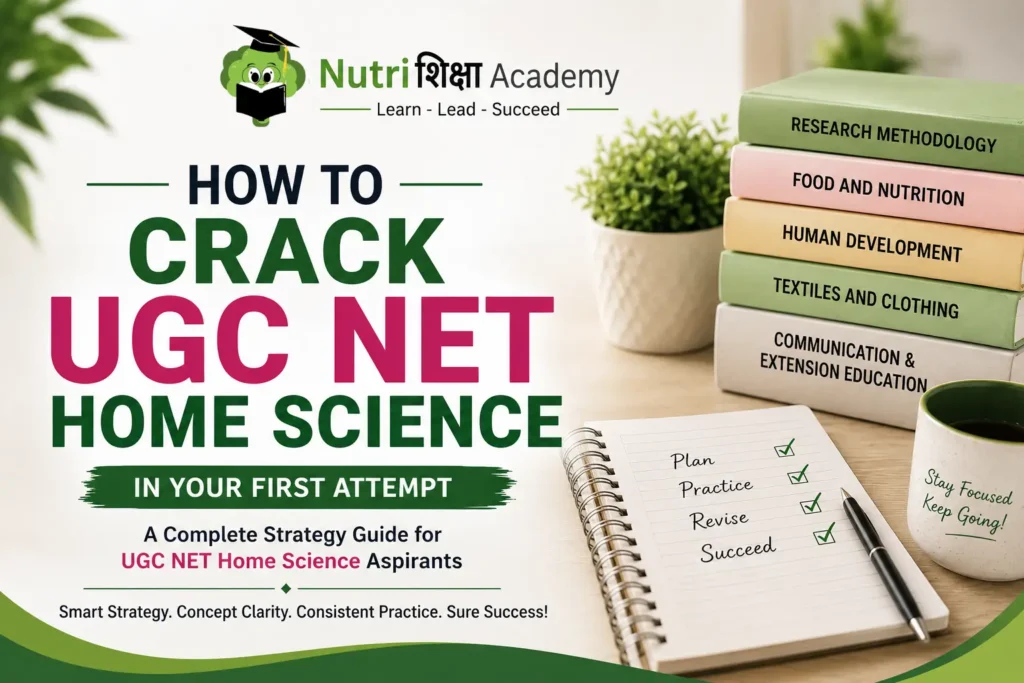
Is your current preparation strategy truly moving the needle, or are you simply drowning in the sprawling, ten-unit UGC NET Home Science syllabus?
For many aspirants, the first attempt feels overwhelming because this subject brings together many different areas such as food and nutrition, human development, textiles, research methodology, communication, and extension education. It is not a subject that can be mastered by random reading or last-minute memorization. What it needs is a clear plan, steady revision, and smart use of time.
The good news is that UGC NET Home Science can be cracked in the first attempt if you prepare in the right way. The syllabus may look huge at first, but once you understand how the exam works and which topics need deeper attention, the whole journey becomes much more manageable. A focused approach can help you study better, remember longer, and feel more confident in the exam hall.
Start with the Right Mindset
The first step is to stop treating the syllabus like a mountain that cannot be climbed. UGC NET Home Science is multidisciplinary, which means it covers a wide range of topics, but that is also its strength. If you study it with understanding instead of fear, many topics begin to connect naturally.
The exam is not only about remembering facts. It also checks your ability to understand concepts and apply them in different situations. This is why students should avoid depending only on rote learning. A better approach is to break the syllabus into manageable parts, understand the basics properly, and revise them again and again. Even a difficult topic becomes easier when you study it in a planned way.
Focus on Concepts, Not Just Notes
One of the most important mistakes students make is collecting too many notes without actually understanding the subject. For UGC NET Home Science, you must build conceptual clarity. This is especially true for topics like research methodology, human development, food and nutrition, and textiles.
Research methodology is often considered difficult by students, but it becomes simple when you understand the meaning of research, types of studies, sampling methods, variables, hypothesis, and data collection tools. This unit is especially useful because it also supports Paper 1. Similarly, food and nutrition is a high-scoring area, but only when your basics are strong. You should know nutrients, deficiency diseases, RDA, digestion, absorption, and diet planning clearly. Human development also needs conceptual understanding, especially when you study the stages of life and the theories of major psychologists. Textiles, too, becomes easier when you understand fibres, yarns, fabric construction, and finishing processes in a logical way.
The more you understand, the less you need to memorize.
Study the Paper as a Whole
Another smart way to prepare for UGC NET Home Science is to connect Paper 1 and Paper 2 instead of studying them as two separate battles. Many topics overlap, and this can save you a
lot of time. Communication and research methodology support both papers. When you notice these connections, your preparation becomes more efficient.
Paper 1 should never be ignored. It may look general, but it can give you valuable marks if you practice it regularly. Topics like reasoning, comprehension, data interpretation, and teaching aptitude improve with daily practice. Even a short daily session can make a big difference in your final score. Many students focus only on subject knowledge and forget that Paper 1 can strengthen the overall result.
The Role of Practice and PYQs
Reading is only one part of preparation. The real improvement happens when you solve questions regularly. Previous year questions are one of the best tools for UGC NET Home Science because they show you the actual pattern of the exam. They help you understand what kind of questions are repeated, which concepts are asked often, and where the paper usually tests depth of knowledge.
PYQs also train you to think faster. In a multiple-choice exam, knowing the answer is not enough; you must also know how to eliminate wrong options. This skill comes only through practice. The more questions you solve, the more confident you become. Along with PYQs, mock tests are also very useful because they train you to manage time and pressure. They help you understand how long you take on each section and where you need to improve.
Revise in a Simple and Smart Way
Revision is one of the most important parts of preparation. Many students study a lot but forget things because they do not revise properly. The best method is to keep your notes short, clear, and easy to read. Use keywords, flow charts, and comparison points wherever possible. This is especially helpful in units like human development, textiles, and research methodology, where many similar terms can create confusion.
You should also revise regularly instead of waiting until the end. Weekly revision helps you stay in touch with old topics and keeps them fresh in your mind. In the final phase of preparation, full-length revision and mock tests become even more important. At that stage, your focus should be on strengthening weak areas and revisiting high-yield concepts rather than trying to study everything from scratch.
A Smarter Way Forward
Cracking UGC NET Home Science in the first attempt is completely possible, but it requires discipline, clarity, and consistency. You do not need to study in a complicated way. You need to study in a planned way. Focus on the major areas such as food and nutrition, human development, textiles, and research methodology. Connect concepts, solve questions daily, and revise with purpose.
A well-structured preparation plan can save time and reduce stress. This is where proper guidance can help a lot. Nutrishiksha Academy is one name that many aspirants look for when they want simple notes, focused preparation, and support for UGC NET Home Science. Their expert-led coaching provides the concise, high-quality notes and mentorship specifically designed to solve the “massive syllabus” problem for Paper 2 Home Science. With the right strategy and regular practice, you can turn a large syllabus into a manageable and scoring journey.